Wax Museum of Greek History by Paul Vrellis

This is the largest wax museum and an important contribution to the history of Greece. Everything in this museum -from the conception of the idea to the execution of the plan-  is the creation of a man who loved his country and chose this special way to depict elements of Greek history. The museum opened in 1995 to provide guests with images from the pre-revolutionary period (the foundation of the Friendly Society, the secret school, etc.), the revolution of 1821 (the Thieves, the death of Ali Pasha etc.) and images of the Second World War (women of Pindos etc.).

English

Folklore Museum of Ioannina

The building dates back to 1800-1808 and was purchased in 1976 by the Society of Epirot Studies. It belonged to Arife and Safie, widow and daughter of Ahmet Mousli respectively. The building had previously been used as a Turkish primary school, teachers' training school, pedagogical academy, boys’ High School and Technical School. The building was re-designed in its interior so that it could accommodate a collection of traditional costumes of Epirus and the surrounding areas, works by local silversmiths as well as pottery, woodwork etc.

Open hours:

English

Bridge of Plaka

This impressive bridge of 1866 has a perfectly rounded arch of approximately 20 meters high. It is 40 meters long and it is the largest of its kind in Greece and maybe even Europe. The bridge was built twice: in 1860 and 1863 when it collapsed on the day of its inauguration. It connects the banks of Arachthos River which was the natural border between Greece and Turkey from 1881 to 1913. There was an outpost, a customs office and an inn near the bridge.

English

Ioannina Lake

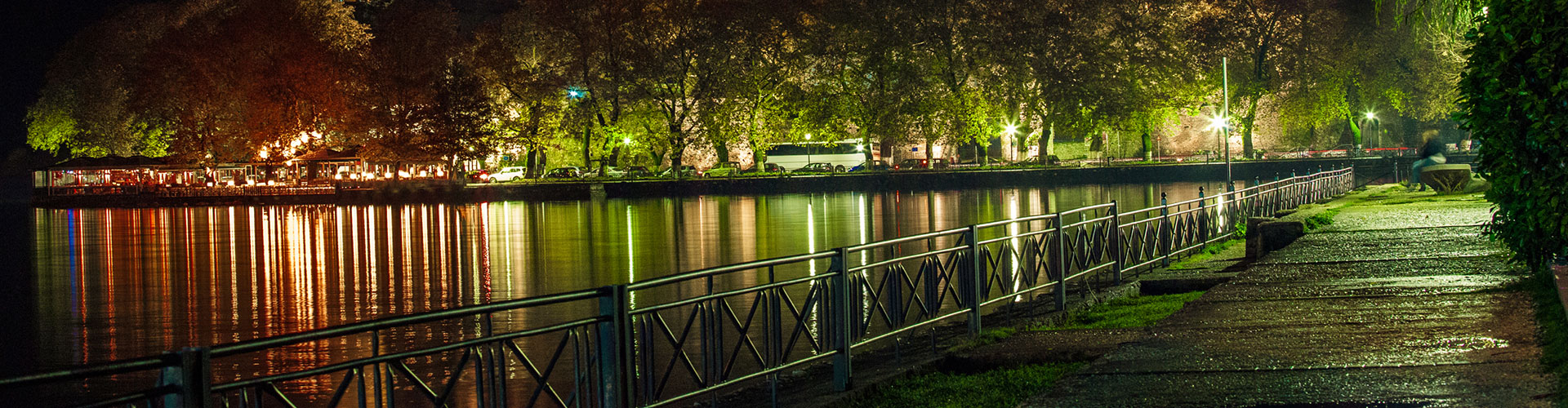
The lake of Ioannina or otherwise Pamvotis Lake is one of the oldest lakes in the world and the second oldest after Lake Ohrid at a European level (about 7 mil. years old). This ecosystem belongs to the European network of protected areas NATURA 2000, due to its rare flora and fauna.

English

Bourazani Park

The Environmental Park Bourazani was founded in 1916 and covers an area of 2050 acres. It was bought by Evangelos Tassos, great grandfather of the current owners. Initially it was used as a pre-winter pasture for the flocks of the family. In 1974 they started buying the first furred game from Yugoslavia, Italy and Austria. With the help of European programs, the family’s own funds and a lot of personal work, the place became a park that people could visit. Nowadays the park hosts six kinds of animals: deer, fallow deer, wild goats of Crete, wild sheep, roe deer and wild boars.

English

Pages

Subscribe to travelfind.gr RSS